
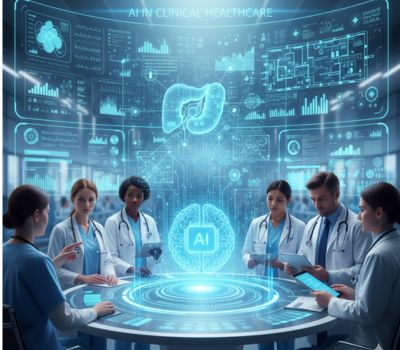
Clinical Transformation
Artificial Intelligence is revolutionizing how clinical healthcare functions. It transforms disease detection, diagnosis, and treatment, making patient care more accurate and proactive.
 Predicts patient admissions & optimizes hospital workflows
 Enables early detection of diseases like sepsis & cancer
 Supports doctors with faster, evidence-based decisions
AI in Clinical Healthcare
Transforming Diagnosis, Research & Patient Care with Intelligence
Smart Resource Management
AI predicts patient admissions, manages hospital resources, and optimizes workflows, helping hospitals operate efficiently.
Early Detection & Diagnosis
AI enables early detection of serious conditions like sepsis and cancer — often outperforming human experts in accuracy.
AI in Disease Diagnosis
Machine learning processes electronic health records and symptom data to support faster, evidence-based decisions.

Drug Discovery & Trials
AI accelerates drug development from discovery to approval, optimizing trial design, patient selection, and safety monitoring.

Clinical Decision Support
Tools like ClinicalKey AI provide clinicians with evidence-based insights, personalized recommendations, and updated references.
Benefits and Future Potential
Personalized Medicine: AI enables customized treatments based on patient-specific data, improving outcomes and reducing side effects.
Predictive Analytics: Algorithms forecast disease outbreaks and patient risks, enabling proactive healthcare decisions and preventive care.
Automation & Efficiency: AI streamlines clinical documentation, radiology imaging, and remote monitoring — enhancing speed and accuracy.
AI in healthcare is steering toward precision medicine, offering faster diagnoses, affordable treatments, and a sustainable healthcare ecosystem for all.
